
.png?width=731&height=305&name=Blog%20Images(7).png)
Here is a truth that doesn't get said often enough: most AI projects don't fail because the technology doesn't work, they fail because the business wasn't ready for it.
We understand the pull. The tools are impressive, the headlines are loud, and every leader we talk to feels the pressure to do something with AI before their competitors do. That urgency is real, but urgency without a foundation doesn't lead to progress. Instead it leads to expensive experiments, frustrated teams and a quiet sense that AI was overhyped.
It doesn't have to go that way.
On a recent episode of our podcast, Edge of Excellence, hosts Jess DeForge and Bryon Beilman sat down with Matt Freake, iuvo's VP of Client Services. Matt has built AI tools inside iuvo and helped client teams put AI to work. The conversation kept coming back to one question: what actually needs to be true inside a business before AI can deliver value?
The short answer: A business is ready for AI when it has a clear business problem to solve, secure and well-governed data, guardrails that protect the company without blocking experimentation, a plan to help people adopt the tools, and metrics tied to real business goals. The technology is the visible part of the work, the foundation underneath it is what determines whether it pays off.
Where should a company start with AI?
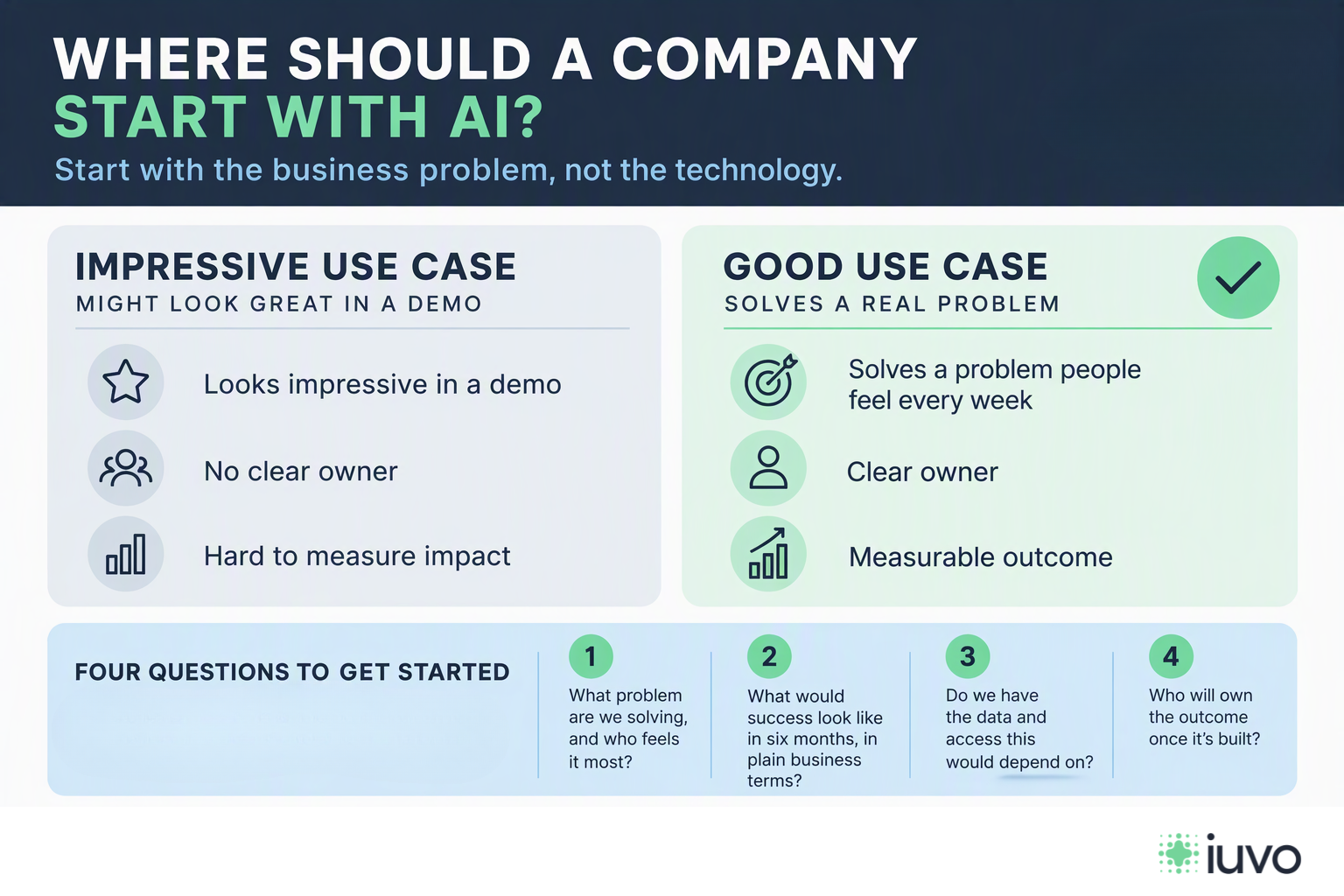
Start with the business problem, not the technology. The most successful AI work begins with an honest look at what isn't working today, not with a tool someone saw in a demo.
When a leader tells us they want to "do something with AI," we don't start by talking about models or platforms. We start by asking what the business does, where it struggles and what outcome would actually matter. Throughout the episode, Matt returned to this again and again.
Understanding the business comes first, because a good AI use case and an impressive AI use case are not always the same thing. A good use case solves a real problem people feel every week. It has a clear owner and an outcome you can measure. An impressive one might make for a great demo, but if it doesn't move the business forward, it will be quietly abandoned.
A few questions help separate the two:
- What problem are we solving, and who feels it most?
- What would success look like in six months, in plain business terms?
- Do we have the data and access this would depend on?
- Who will own the outcome once it's built?
If you can't answer those yet, it's a sign of where the real work begins.
What security questions should you answer before using AI?
Before sensitive business information goes into any AI tool, you need to know where that data goes, who can see it and whether it's being used to train someone else's model.
Let's be honest about free tools. They are tempting and they are easy, but as Bryon put it on the episode, when you use a free AI service, the provider is often training on your data. For a business, that's a risk you can't afford to take casually. The better path is an enterprise agreement with an established AI provider, one that keeps ownership of your data with you and keeps it out of public training sets.
The second question is about access. Bryon made a point that many leaders find counterintuitive. It is better for data to be locked down, with people asking for permission when they need it, than to discover that someone has connected an AI tool to every piece of data the company owns. That kind of surprise is avoidable. Compartmentalizing and securing data before an AI project begins means that when the time comes, nobody is caught off guard.
This matters most with tools like Microsoft Copilot. As Matt explained, Copilot uses whatever permissions each person already has. If those permissions are messy, Copilot will surface things people were never meant to see. That's why a Copilot readiness assessment comes first. Once you have a clear, confident picture of who has access to what, people can use Copilot freely, because it's effectively a faster version of them working inside their own Microsoft environment.
Done early, security is the thing that lets you move quickly with confidence.
How do you govern AI without stopping experimentation?
Give people wide freedom to use AI, and build clear guardrails around that freedom. Governance should protect the business, not bury good ideas under paperwork.
This is a balance every organization has to strike. Too little structure, and you invite risk. Too much, and people stop trying new things. Matt's view is that in a perfect world, you give people a lot of room to explore, as long as the right guardrails are in place first.
Those guardrails look different depending on what people are doing. Using Copilot inside a well-permissioned Microsoft environment is one thing. Building software is another.
More and more, that's exactly what's happening. With tools like Claude Code, many companies are developing software for the first time, often by people who have never written code before. That's an exciting shift, but it also means businesses need practices that software companies have relied on for years:
- A software development lifecycle (SDLC). A defined process for how software is planned, built, tested and deployed.
- A central code repository. Code should live somewhere like GitHub, owned by the organization, not scattered across personal laptops.
- Secure cloud hosting. The most valuable AI tools often connect several SaaS applications, which usually means hosting them in Azure or AWS. That requires people who understand the security implications of building there.
At iuvo, one practice has worked especially well. Organizational standards can be set inside a company's Anthropic account, such as a rule that all code gets checked into GitHub at least daily and passes certain security checks. It isn't a hard enforcement, the AI will consistently remind people to follow those standards, or simply follow them itself. As more people who are new to coding start building, that gentle, constant nudge makes a real difference.
Matt also offered advice for anyone building for the first time: ask the AI to teach you while it builds. Tell it you want to understand how the tool works and what the security risks are. It will build what you asked for, and it will explain its choices, flag risks and warn you about mistakes like exposing API keys. That is a powerful way to learn.
What does effective AI training look like?
Effective AI training starts with work that matters to each person, not a list of features. People adopt AI fastest when they get an early win on a task they actually care about.
For a long time, when Matt had a question about AI, people would tell him to just ask AI. It didn't click. Part of that was timing, since the tools weren't as good yet, but part of it was that nobody had shown him how it connected to his own work.
That experience shapes how iuvo trains client teams today. You could list every possible use case, but you would bore people to death. Instead, the training focuses on experiential learning, grounded in the business and the work people do every day. Say someone needs to combine seven Excel spreadsheets into something that makes sense. That's a relevant, concrete starting point, and it teaches more than any slideshow could.
There's one question Matt likes to ask in this process, and it's worth borrowing:
What's something you find yourself doing regularly in your job that you don't like to do?
Most of the time, the answer is something AI can help with, whether that's building a small tool or improving a process, and once people see that first win, their creativity takes over. They start finding new ways to improve their own work.
The other half of adoption is removing fear. People need to know the tool is company-approved and secured to their organization, and that they don't need to worry about what they share with it. When people feel safe, and when they understand the guardrails, Matt has seen adoption and learning happen remarkably fast.
How do you measure AI ROI?
Measure AI against your business goals, not against how much people use it. Adoption alone is not a result. Time saved, capacity gained and growth without added cost are.
Matt described a shift many organizations went through this year. Early on, the only metric a lot of companies cared about was adoption. They wanted to see usage going up. Then the bills arrived, and leaders started asking a better question: what are we actually getting for this?
That question leads back to where every good AI effort should begin, with clear goals. From there, the right metrics tend to follow:
- Time savings. This is often the easiest place to start. If someone spends hours every week gathering data from different systems, an automated dashboard can hand that time back. The ROI is clear because the work that took hours is simply done.
- Capacity. Many organizations are finding they can do more with the team they already have.
- Growth without added cost. The ultimate measure may be revenue and profit rising while costs hold steady.
Matt was careful to add that the right metrics should always be specific to your organization. There is no universal scorecard.
That's also why he encourages leaders to look beyond their own walls. Talking with peers in your industry about how they use AI can spark ideas you'd never reach alone. It also keeps you aware of how your industry is changing. In pharmaceutical R&D, for example, companies are weighing a real and unsettled question. If AI helps develop a new drug, what does that mean for ownership of it? Some companies are moving ahead, others are limiting AI in research until the rules are clearer. Knowing where your industry stands on questions like that is part of being ready.
-2.png?width=1536&height=1024&name=Blog%20Graphics(1)-2.png)
What should a CEO do first to get serious about AI?
Understand the business, lead adoption from the top and put security guardrails in place. Those three steps can happen side by side, but none of them can be skipped.
When asked what he would tell a CEO who wants to get serious about AI, Matt was candid. There is no quick, flashy answer, and the right path will look different for every company, but the principles hold:
- Understand the business and its biggest pain points. Before anything else, get clear on where AI could have the most impact. That usually takes a real conversation, and the answer may surprise you.
- Lead from the top. When a CEO uses AI openly, sets clear goals and shares the wins, it gives everyone else permission to explore and build.
- Make sure people can work securely. Guardrails, clear processes, the right access and a good acceptable use policy are the price of admission. Put them in place before you ask everyone to go all in.
None of this is glamorous, but this is the work that makes the difference between AI that impresses and AI that endures.
-2.png?width=1536&height=1024&name=Blog%20Graphics(2)-2.png)
Frequently asked questions about AI readiness
What is AI readiness? AI readiness is the degree to which an organization has the foundation to use AI successfully. That includes a clear business problem, secure and well-governed data, appropriate access controls, guardrails and policies, a plan for adoption and metrics tied to business goals.
What is an AI readiness assessment? An AI readiness assessment is a structured review of whether your organization is prepared to adopt AI. It typically examines data access and permissions, security, governance, workflows and where AI could have the most business impact.
Do I need a readiness assessment before rolling out Microsoft Copilot? In most cases, yes. Copilot uses each person's existing permissions, so any access problems in your Microsoft environment will surface through it. A readiness assessment gives you confidence in who has access to what before you roll it out.
Are free AI tools safe for business use? Free AI tools often use your data to train their models. For business use, an enterprise agreement that keeps ownership of your data and excludes it from training is the safer choice.
Why do AI projects fail? AI projects most often fail because of missing foundations, not because the technology doesn't work. Common causes include an unclear business problem, poorly governed data, no clear owner, weak adoption and success measured by usage instead of business outcomes.
How should a company measure AI ROI? Start with business goals, then measure outcomes like time saved, increased team capacity and revenue or profit growth without added cost. Usage on its own is not a meaningful measure of ROI.
Who should own AI governance? AI governance should be shared. IT and security teams set the guardrails, access controls and technical standards. Business leaders own the use cases, the outcomes and the example they set for their teams.
You don't have to figure this out alone
If you've read this far, maybe you recognize your own organization somewhere in these pages. Perhaps your team is experimenting but hasn't seen real results. Maybe you're about to roll out Copilot and aren't sure your permissions are ready. Maybe you simply know AI matters and don't know where to begin.
Wherever you are, that's a fine place to start. What matters is the next step.
Talk with iuvo about your AI readiness. We'll connect you directly with Brian St. Marie, our VP of Technology, who leads iuvo's AI research and experimentation. We'll learn about your business, talk through where AI could make the biggest difference and give you an honest view of what needs to be in place first.
Schedule your AI readiness conversation
The promise of AI is real. With the right foundation, your business can be ready to realize it.
-2.png?width=1536&height=1024&name=Blog%20Graphics(3)-2.png)
How We Create Our Content
As a future-ready technology company, we embrace AI as an accelerator to empower our teams and enhance the way we create. We believe that the reliability of AI technology depends on the people behind it, which is why every blog is supported by AI tools and then carefully reviewed, validated, and enriched by our subject matter experts. This balance enables and empowers our team to produce content that is useful, accurate, and trustworthy for our readers.
-2.png)