
.png)
.png?width=731&height=305&name=Blog%20Images(7).png)
Cloud computing gives organizations unprecedented flexibility. Teams can provision infrastructure in minutes, scale resources as demand changes, and access powerful computing capabilities without investing in physical data center infrastructure.
But that flexibility comes with a tradeoff: the same ease and speed that make the cloud so valuable can also make it easy to lose track of what you're spending.
A development environment created for a short-term project can continue running long after the project ends. A database can be provisioned with far more CPU, memory, or storage than it actually needs. A company can migrate an on-premises server to the cloud without changing its architecture—and discover that the "cloud version" costs more than the infrastructure it replaced.
The result is often the same: a cloud bill that grows faster than expected, with limited visibility into why.
The good news is that you can control cloud costs by using the right resources, for the right workloads, with the right governance in place.
As Brian O'Neill, Principal Consultant at iuvo, explains, effective cloud cost management starts with understanding what is actually happening inside your environment and building systems that make that visibility repeatable.
Why Cloud Costs Can Get Out of Control
One of the fundamental differences between traditional infrastructure and cloud computing is how resources are purchased and consumed.
In a traditional data center, an organization typically makes a capital investment in physical servers and infrastructure. In the cloud, you're effectively renting computing resources and services. The more you use, and in many cases the longer resources remain allocated, the more you pay.
That creates a unique challenge.
Cloud platforms such as AWS and Microsoft Azure make it remarkably easy to create resources. A user can provision a virtual machine, database, storage environment, or other service with just a few clicks or commands.
That convenience is one of the cloud's greatest strengths, it can also become one of its greatest cost risks.
As Brian puts it, the person creating the resource isn't necessarily the person responsible for the bill. A developer might create several virtual machines to test an application, finish the testing, and move on to the next project. If those resources aren't automatically shut down or removed, they can continue generating costs indefinitely.
Over time, those small decisions can become significant expenses, and because cloud environments can contain hundreds or thousands of resources, identifying the source of unnecessary spend isn't always straightforward.
The Hidden Cost of "Just Put It in the Cloud"
One of the most common misconceptions about cloud migration is that moving existing infrastructure to the cloud will automatically make it more cost-effective.
It doesn't.
A traditional server can be moved into a cloud environment relatively easily by creating a virtual machine with similar specifications. This "lift-and-shift" approach can be useful when speed is the priority, but simply recreating an on-premises environment in the cloud doesn't necessarily take advantage of what cloud platforms are designed to do.
For example, an organization might run a large virtual machine 24/7 because that's how its application operated on-premises, but cloud environments provide other ways to architect workloads.
Instead of relying exclusively on large, continuously running virtual machines, organizations can take advantage of cloud-native services, automation, and architectures designed to scale resources according to actual demand.
The difference can be substantial.
Cloud optimization isn't simply about moving infrastructure. It's about rethinking how that infrastructure should operate once it's there.
Right-Sizing Your Cloud Environment
Another major source of unnecessary cloud spend is over-provisioning.
When an application is new, it can be difficult to know exactly how much CPU, memory, storage, or other resources it will require. Organizations often respond by allocating more resources than they expect to need.
From a performance perspective, that can seem like the safer choice.
If a website is slow because it doesn't have enough resources, customers have a poor experience, but if the environment has significantly more resources than necessary, the organization may be paying two, three, or even four times what it actually needs.
The answer isn't simply to choose smaller resources.
Instead, organizations should monitor how environments perform over time and use that information to right-size them.
This creates a continuous cycle:
- Establish an appropriate baseline.
- Monitor actual resource utilization.
- Identify underutilized or over-provisioned resources.
- Adjust resources based on real workloads.
- Continue monitoring as usage changes. This is particularly important for applications with unpredictable or seasonal demand.
.png?width=1536&height=1024&name=Blog%20Graphics(1).png)
Scale Up vs. Scale Out
Architecture also plays a major role in cloud cost optimization.
There are two fundamental approaches to scaling an application: scaling up and scaling out.
Scaling up means increasing the capacity of an existing resource, for example, moving an application to a larger virtual machine.
Scaling out means adding additional resources to distribute the workload.
Scaling out can provide greater flexibility because resources can be added when demand increases and removed when demand decreases. For example, an organization might automatically add additional resources when thousands of users suddenly visit a website and then scale those resources back down once traffic returns to normal.
That means the organization isn't paying for peak capacity when it's only needed occasionally.
However, scaling out requires an application architecture that supports it. Applications that rely heavily on maintaining user state or have other architectural dependencies may require additional design considerations before they can scale effectively.
This is why cloud cost optimization needs to happen at the architecture level, not just the billing level.
.png?width=1536&height=1024&name=Blog%20Graphics(2).png)
The Problem With Forgotten Resources
Some of the easiest cloud costs to eliminate are also some of the easiest to overlook.
Consider a development environment created to test a new application.
The team finishes its work, but the environment remains active.
Or a production database is duplicated for testing, but the development copy receives the same amount of CPU, memory, and storage as production even though it handles a fraction of the workload.
Or someone creates a temporary environment to learn a new cloud service and simply forgets that it exists.
These resources may not cause an obvious problem day to day. They're just quietly accumulating costs.
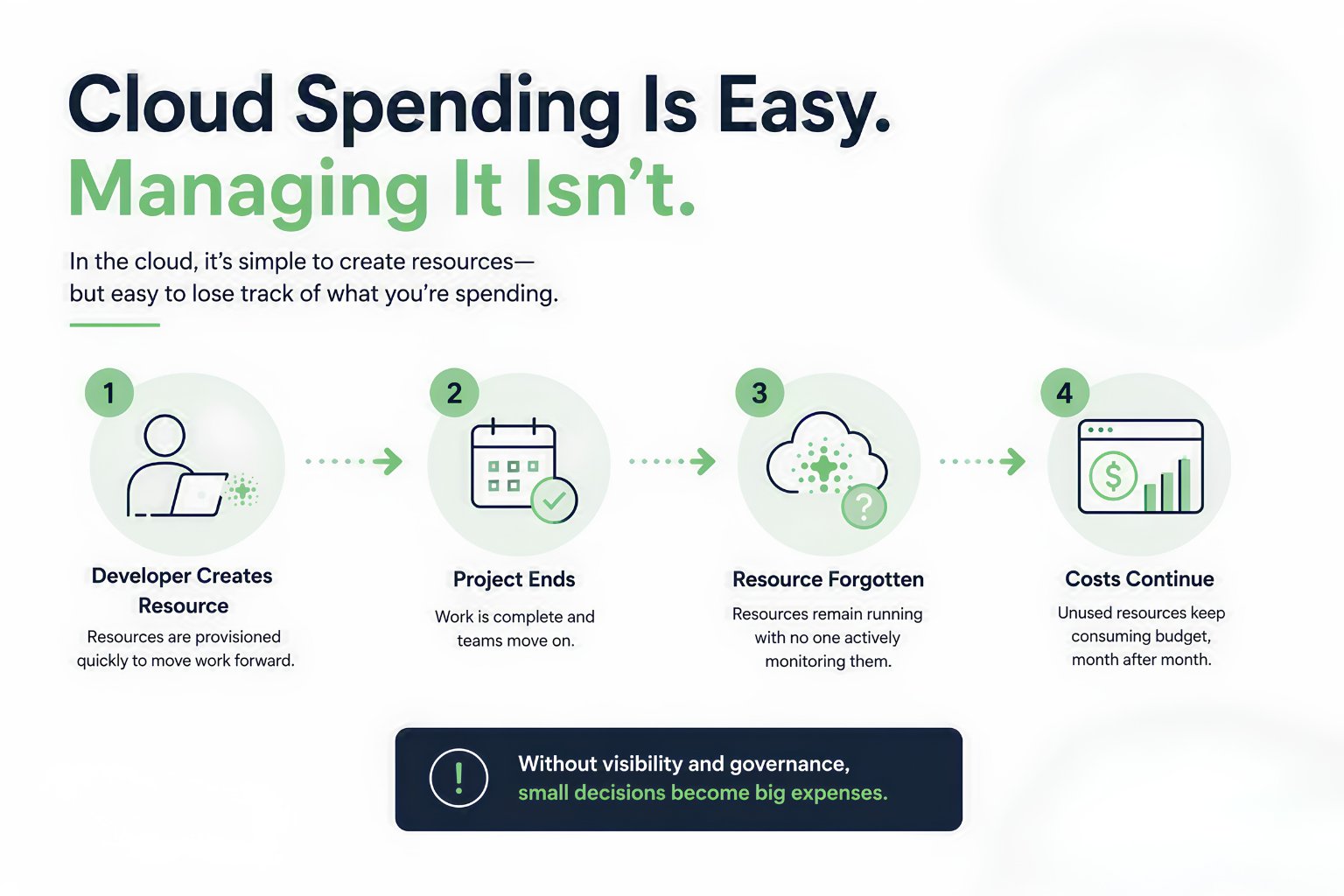
In one client example discussed during the Edge of Excellence podcast, an environment contained multiple databases that were much larger than necessary. Some were copies created for development and testing. Once the environment was assessed, the team was able to eliminate resources that were no longer needed and right-size others.
The result was approximately $50,000 in savings.
The lesson is that you can't optimize what you don't know you have.
Visibility Is the Foundation of Cloud Cost Governance
The first step toward controlling cloud costs isn't necessarily cutting anything.
It's understanding what's there.
A high-level cloud bill can tell you how much you're spending and may break costs down by service, but that information alone often doesn't answer the questions decision-makers actually need to ask:
- Who owns this resource?
- What application does it support?
- Which department is responsible for the cost?
- Is it production, development, or testing?
- When was it created?
- Is it still being used?
- How much is it costing?
- Who should review it?
This is where cloud governance becomes essential.
One practical mechanism is resource tagging. Organizations can establish standardized tags that identify information such as the resource owner, creation date, application, department, review date, or provisioning method.
That creates a much clearer picture of the environment.
Instead of seeing an unexplained collection of resources, teams can begin connecting infrastructure to business ownership and purpose.
Cloud account and subscription structures can provide another layer of financial visibility. Organizations can use separate AWS accounts or Azure subscriptions to establish clearer boundaries between departments, applications, environments, or other organizational units.
The important point is to think about this structure before the environment becomes difficult to change.
It is much easier to establish logical boundaries when you're building an environment than to untangle years of accumulated infrastructure later.
.png?width=1536&height=1024&name=Blog%20Graphics(3).png)
Governance Shouldn't Become a Bottleneck
The word "governance" can sometimes sound like bureaucracy.
That's not what effective cloud governance should be.
If every developer has to submit a ticket and wait days for IT to provision a test environment, the organization has created a process that protects costs at the expense of productivity.
The better approach is to create guardrails rather than roadblocks.
For example, an organization can establish policies that require resources to include certain tags when they're created. It can automatically shut down development environments outside of business hours. It can restrict the types or sizes of resources that can be provisioned in certain environments.
Infrastructure as code can take this even further.
Infrastructure as Code: Building Repeatability Into the Environment
Infrastructure as code allows organizations to define cloud infrastructure programmatically rather than manually creating individual resources through a web interface.
Instead of clicking through a series of configuration screens, teams can create code that describes what the environment should look like.
That approach provides several advantages.
Consistency: Environments can be created according to a defined configuration rather than individual preferences.
Speed: Entire environments can be provisioned much faster than creating each resource manually.
Repeatability: The same configuration can be used to create multiple environments.
Documentation: The infrastructure configuration itself becomes a record of how the environment is constructed.
Governance: Policies and required configurations can be incorporated into the provisioning process.
This can be especially valuable for development and testing environments. Once a standardized environment is defined, teams can potentially request or create copies of it without recreating the architecture manually every time.
Don't Wait for the Cloud Bill to Tell You Something Is Wrong
One of the most important insights is that the cloud bill itself is often a lagging indicator.
If an organization receives a $5,000 bill when it expected to spend $500, the problem has already happened.
Cloud platforms provide tools that can help organizations become more proactive.
For example, teams can establish budgets and configure alerts when spending is approaching a defined threshold or when projected spending indicates that a budget may be exceeded.
These alerts create an opportunity to investigate before the end of the billing cycle.
Imagine that an account typically costs $500 per month, but a budget alert indicates that projected spending will exceed that amount early in the month.
That doesn't necessarily mean something is wrong. Perhaps traffic increased unexpectedly, and the additional spend is justified, but it creates an important question:
Why is spending increasing?
If the increase is legitimate, the organization can make an informed decision. If it's the result of an unexpected resource, misconfiguration, or compromised account, the team has an opportunity to respond before the expense grows significantly.
The difference is moving from reactive cost management to proactive cost governance.
Security and Cost Management Are Connected
Cloud cost governance isn't only a financial issue.
It's also a security issue.
Cloud resources can be provisioned easily, making poorly secured accounts easier to exploit by unauthorized users. A compromised account can suddenly begin generating substantial costs as attackers provision computing resources for malicious activity.
This makes cloud governance part of a broader security strategy.
Organizations should know:
- What resources exist.
- Who can create them.
- Who owns them.
- What they are being used for.
- What controls are applied to them.
- How unusual activity will be detected.
- What happens when something falls outside established expectations.
Visibility, governance, and security reinforce one another.
Should Everything Be in the Cloud?
Cloud isn't automatically the right answer for every workload.
Certain workloads can be extremely expensive to operate in the cloud.
Brian gives the example of electronic design automation environments, where organizations may run intensive simulations and computational workloads continuously. When those workloads require powerful infrastructure running 24/7, the economics can look very different.
If a workload is consistently consuming significant computing resources, there may be situations where owning infrastructure, or using a different hosting model, makes more financial sense than paying for equivalent cloud capacity indefinitely.
The objective shouldn't be: "How do we get everything into the cloud?"
It should be: "What infrastructure model makes the most sense for this workload and our business?"
That distinction is critical.
When Should You Bring in Cloud Expertise?
Organizations don't necessarily need an outside cloud consultant on day one.
But there are clear signs that additional expertise may be valuable.
Consider bringing in cloud expertise if:
- You aren't sure what is driving your cloud costs.
- Your cloud bill has increased unexpectedly.
- You have resources that nobody can confidently identify.
- Development and testing environments are consuming significant spend.
- Your environment was primarily built through lift-and-shift migration.
- You aren't sure whether workloads are appropriately sized.
- Multiple teams can provision resources without centralized visibility.
- You don't have consistent tagging or ownership standards.
- You aren't confident that your current architecture is taking advantage of cloud-native capabilities.
- You're considering a major cloud migration or expansion.
An experienced cloud consultant can evaluate the environment from both a technical and business perspective, looking not only at what resources exist, but why they exist, how they're being used, and whether the architecture makes sense for the workload.
Sometimes the answer is to optimize the cloud environment.
Sometimes it's to redesign part of the architecture.
Sometimes the answer is that a particular workload may not belong in the cloud at all.
The Goal Isn't Lower Cloud Spend. It's Better Cloud Spend.
Cloud cost optimization is sometimes framed as a cost-cutting exercise.
That's too narrow.
The real objective is to create an environment where every dollar spent on infrastructure has a clear purpose.
That requires visibility, ownership, thoughtful architecture, automation, and most importantly, it requires governance that provides guardrails without preventing people from doing their jobs.
As Brian explains, the goal isn't to create so much control that users have to wait for IT every time they need a resource. The goal is to give teams the freedom to work while establishing enough structure to understand what's being created, why it's being created, and whether it's still needed.
Ultimately, if there is something in your cloud environment and nobody knows what it does, you have already lost some degree of control over your costs.
The cloud can be incredibly powerful, but realizing that value requires more than simply moving infrastructure into AWS or Azure.
It requires an intentional strategy for how that environment is designed, managed, monitored, and governed.
Is Your Cloud Environment Costing More Than It Should?
If you're unsure where your cloud spend is going, struggling to manage AWS or Azure costs, or wondering whether your current architecture is optimized for your workloads, an assessment can help identify opportunities for improvement.
Schedule a consultation with iuvo to explore your cloud environment, identify potential areas of waste, and develop a more secure, scalable, and cost-effective approach to cloud management.
How We Create Our Content
As a future-ready technology company, we embrace AI as an accelerator to empower our teams and enhance the way we create. We believe that the reliability of AI technology depends on the people behind it, which is why every blog is supported by AI tools and then carefully reviewed, validated, and enriched by our subject matter experts. This balance enables and empowers our team to produce content that is useful, accurate, and trustworthy for our readers.
-2.png)