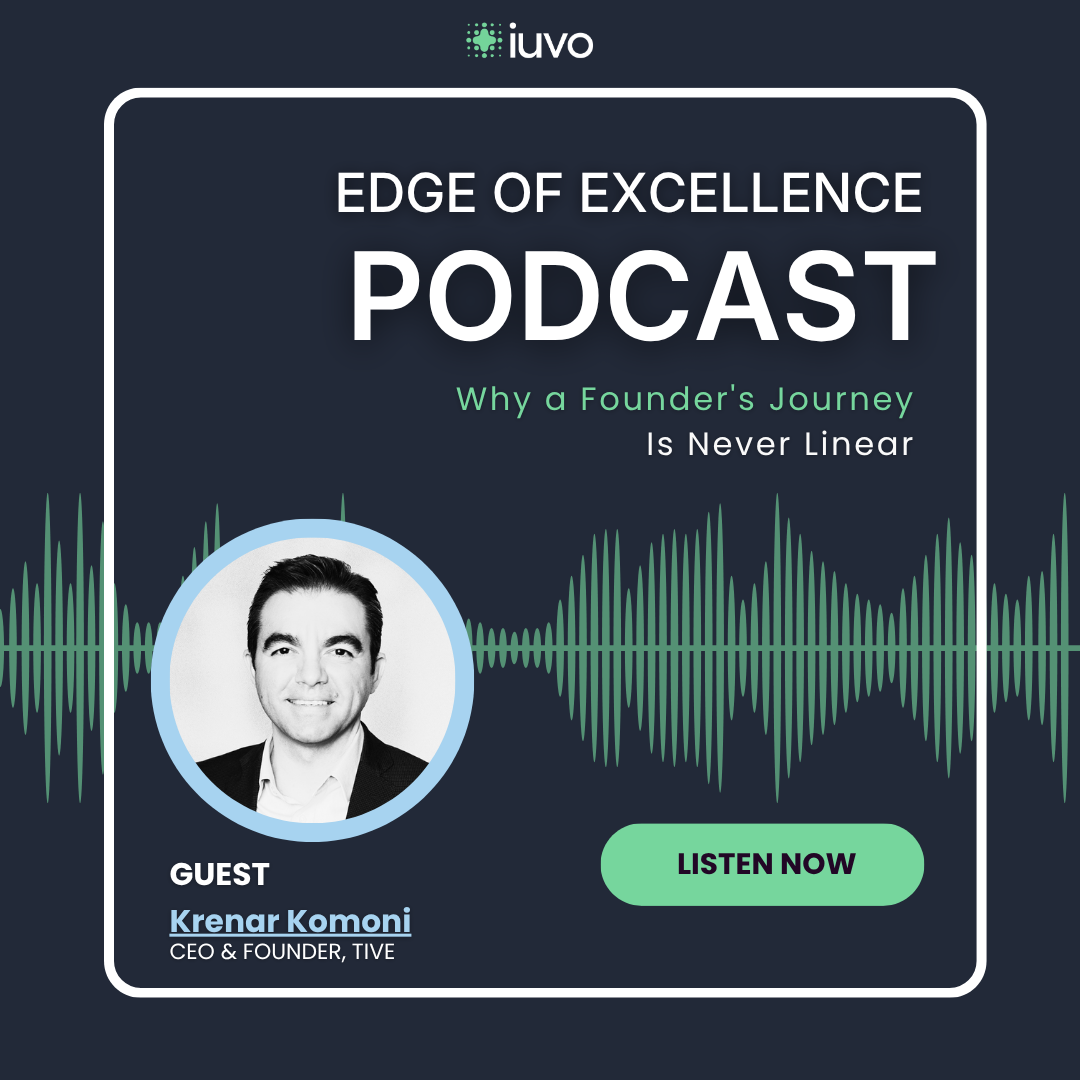
Click here to listen now: Why a Founder's Journey Is Never Linear: Lessons from Tive CEO Krenar Komoni
What does a software-defined radio chip have to do with knowing where your pharmaceuticals are mid-shipment? For Krenar Komoni, CEO and founder of Tive, the through-line is clearer than you might think, and it starts with a deep love of wireless technology, an entrepreneurial spirit that showed up at age 16, and a problem he watched his father-in-law live with every day.
In this episode of Edge of Excellence, Jess DeForge and Bryon Beilman sit down with Krenar for a candid, wide-ranging conversation about a career that has wound through wireless chip design, startup setbacks, and the pivots that turned a basement prototype into a global supply chain visibility company.
An Entrepreneurial Foundation
Krenar grew up in Kosovo and got his first taste of building something from nothing at 16, when he helped launch a television station from the ground up, creating 3D animations for news broadcasts and watching a brand-new channel reach hundreds of thousands of viewers. "Once you do that once, it's a bug in you," he says. "Entrepreneurship, it doesn't leave."
That bug stayed with him when he moved to the US and landed an internship at Bitwave Semiconductor (where he and Bryon first crossed paths) after his junior year at Norwich University. It was 2005, and Bitwave was building something genuinely ambitious: a software-defined radio on a chip that could be programmed to work across 2G, 3G, 4G, LTE, and Wi-Fi, all in software. It was there that Krenar fell in love with wireless technology.
"We're talking right now with no wires," he says. "A microphone with no wires. It's pretty amazing, wireless, and how abstract it is and how powerful it is."
What Chip Design Teaches You About Leading People
One of the most memorable lessons Krenar carries from his chip design days has nothing to do with transistors. It's about the power of bottom-up management.
At Bitwave, the team was perpetually missing tape-out deadlines (a "tape out" being the moment a chip design is finalized and sent to the fabrication factory, a high-stakes, no-going-back milestone). Krenar, then a junior engineer, asked the CTO if he could talk directly to every engineer working on different parts of the chip to build a ground-up timeline estimate.
The CTO said: go for it.
Krenar built a spreadsheet. His timeline estimate came in within two weeks of the actual result. "The best way sometimes is bottom up," he says. "I work a lot with my executive team and leadership team, but I talk to almost every employee if I can, trying to understand what's really going on with the business."
It's a philosophy he still runs with at Tive, which now has roughly 300 employees and is on track to hit $100 million in revenue.
The Origin of Tive: A Family Dinner Table Problem
Tive didn't start with a pitch deck or a market research report. It started with Krenar watching his father-in-law, a trucking company owner, struggle to get reliable, real-time visibility into his fleet and cargo.
Krenar knew wireless and RF technology. His father-in-law had trucks. The connection seemed obvious, but what he saw in the market stopped him cold: while consumers were walking around with beautifully designed iPhones and intuitive apps, the tools available to logistics operators were, in his words, "a black box with a switch."
"People in the warehouse are people," he says. "People in logistics are also people. People like myself using an iPhone are also humans. I think people in business and in everyday enterprise dealing with supply chain logistics deserve good design and good taste and good experiences."
This conviction, that enterprise software didn't have to be ugly or confusing, became the design philosophy behind Tive from day one. His mother was a poet and journalist; his father, a mechanical engineer. "Somehow I got both the brains a little bit," he says with a laugh.
The Pivots That Built the Company
Here's what Krenar's initial assumptions about Tive's market got wrong: almost everything.
He started thinking his customer was trucking companies. Within a month or two, he pivoted, realizing he wasn't tracking the truck, he was tracking the goods inside the truck. Then he assumed his target vertical would be pharma, given the obvious need for temperature-controlled visibility around vaccines and life science products. But pharma compliance, regulatory requirements, SOC 2 Type II certification, and ISO standards took years, until just recently, to fully achieve.
"I thought life sciences was going to be a piece of cake," he says. "It wasn't."
So he went into food, and food turned out to be a great vertical. "I just love food customers," he says. From there, Tive expanded into high-value electronics, industrial, logistics service providers, and now, finally, life sciences.
The lesson he draws: listen to the market, not your assumptions.
Transparency as a Core Value
When Krenar talks about Tive's values, he doesn't recite a list of corporate platitudes. He explains exactly how each value shows up operationally.
Transparency, for example: "If you're transparent, that means you're transparent with employees. You're transparent with customers. Transparent with customers, that's your brand. Transparent with employees, that's your culture." The value isn't just a principle; it's the connective tissue between internal culture and external promise.
Another value, "we have each other's backs", directly shapes how teams interact with customers. When a customer has an issue, customer support, sales, and account management work on it together rather than pointing fingers. "The customer sees a unified voice coming from Tive," Krenar says. "And then the customer feels it. This is a unified company."
Bryon captures the flip side well: "Divide and conquer. If you see a company where departments are saying different things, you have leverage as a customer." Unity removes that leverage in the best possible way.
The Moment Tive Became Real
The real turning point, Krenar says, wasn't a product milestone or a revenue number. It was a psychological shift that happened in the summer of 2019, when Tive had about $10,000 in the bank and he was spending hours on the phone with investors and VCs in parking lots and on walks, trying to raise enough money to keep the lights on.
"I realized: even if this company goes bankrupt next week, I'm going to start it again. I'm going to do this thing again." That switch flipping, the commitment that existed independent of outcome, is what he points to as the moment he knew Tive was going to work. Revenue at the time: roughly $150,000 to $200,000.
Today: on track for $100 million, growing at 50% annually, with over four million devices shipped.
What Tive Actually Tracks (It's Much More Than GPS)
Most people assume supply chain visibility means GPS tracking. Tive's hardware goes significantly further.
Each tracker includes a temperature sensor (critical for food, pharma, and cold chain), a light sensor that detects if a trailer door has been opened (potential tampering), a humidity sensor, an orientation sensor to detect if a shipment has been tilted or turned upside down, and a shock sensor for sensitive materials. There's also a Bluetooth-connected electronic seal that alerts users the moment a trailer is physically breached, unlike a traditional plastic or metal seal that can be cut without anyone knowing.
On the software side, customers can configure geofences, route deviation alerts, temperature thresholds, and custom workflows, replacing what used to be a patchwork of carrier calls, emails, and multiple tracking platforms.
One particularly clever new capability: Tive has developed a machine learning algorithm that detects whether a refrigerated trailer's cooling unit is running continuously (as specified) versus cycling on and off (as carriers sometimes do to save money). If a carrier is supposed to maintain 32°F continuous but is cycling between 32° and 40° to cut costs, Tive can flag it and alert the customer to make a call.
"It's going to save more, it's going to increase shelf life of products when it comes to produce and fruits and vegetables," Krenar says. "It's just going to make things better."
On Work-Life Balance
Asked about balance, Krenar gives an honest answer: "I don't think there's a balance." It's not 50/50. It's not even 75/25 most of the time. In the early years, it was 99% work, because if he didn't put it in, nobody would.
What's changed as Tive has scaled is that he now has an executive team and leadership layer that allows him to operate more strategically. "That lets me have a little bit more time to think about strategy and where we're going to go as a business." But he's clear that this came from years of finding, growing, and sometimes replacing people as the business's needs evolved.
"The best way I've realized is to find people who have really gone through this scale and experienced it at least once," he says. People who've lived the transition from a $5 million company to a $25 million company have an instinct for it. Others can grow into it, if they're wired for change.
The Advice That Stuck
Krenar's best piece of advice is the same lesson he learned as a junior engineer at Bitwave: don't wait for permission.
"I don't think anybody out there is going to lay a red carpet for you to do something. Just go and do it.”
His advice to his younger self? Start sooner. Don't wait for the right time. "Do you want to do it when you're older? Every day we're getting older. Every day."
Where to Find Krenar and Tive
Subscribe to Edge of Excellence and visit iuvotech.com to learn more.
How We Create Our Content
As a future-ready technology company, we embrace AI as an accelerator to empower our teams and enhance the way we create. We believe that the reliability of AI technology depends on the people behind it, which is why every blog is supported by AI tools and then carefully reviewed, validated, and enriched by our subject matter experts. This balance enables and empowers our team to produce content that is useful, accurate, and trustworthy for our readers.
-2.png)